On this page
The short version
- Push days train chest, shoulders and triceps; pull days train back and biceps; legs days train the lower body.
- Run it 3 days (each day once a week) or 6 days (each day twice). Six days doubles your weekly sets.
- At equal weekly sets, training 3 or 6 times a week gave similar results in a study of trained lifters.
- Progress with double progression and log every set.
How Push / Pull / Legs works
Push / Pull / Legs (PPL) splits your training by movement. Muscles that work together on the same day share the warm-up and the fatigue, and the next day trains something else.
| Day | Muscles | Main lifts |
|---|---|---|
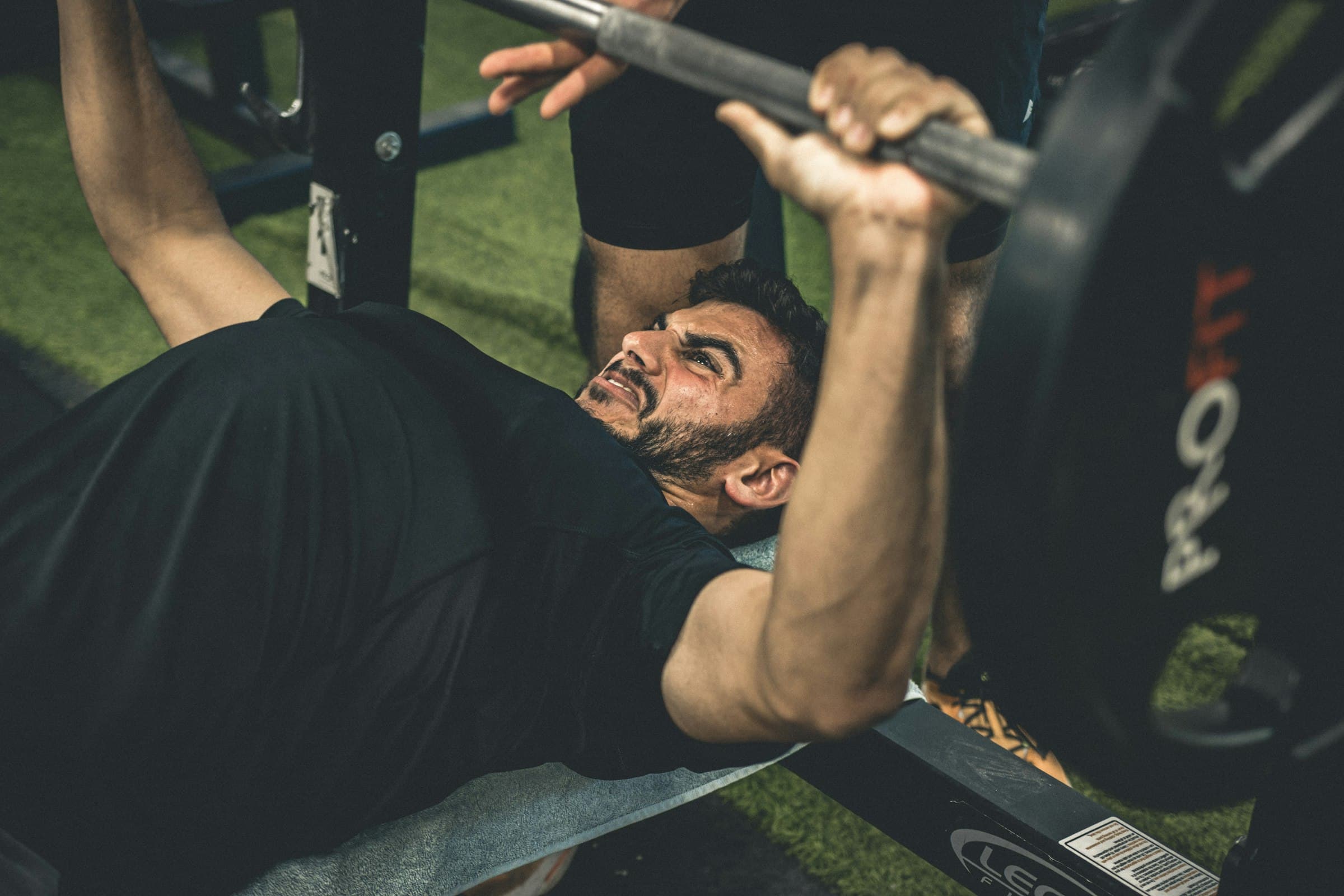
| Push | Chest, shoulders, triceps | Bench press, overhead press |
| Pull | Back, rear shoulders, biceps | Rows, pull-ups |
| Legs | Quads, hamstrings, glutes, calves | Squat, Romanian deadlift |
3 days or 6 days?
With three days, each muscle is trained once a week. With six, twice. A study of trained men found that 3 and 6 sessions a week gave similar strength and muscle gains when weekly sets were the same [1], and a larger review found the same for muscle size [2].
So the real difference is how many sets you can fit in. Three days of the workouts below give about 7 direct chest sets a week; six days give about 14. The ACSM's 2026 review ties 10 or more weekly sets per muscle to more growth [3]. Strength also tends to improve more with more frequent training [4].
- 3 days if you are newer, short on time, or want lots of recovery. Consider the 3-day full-body plan instead if you want each muscle twice a week.
- 6 days if you have trained consistently for a year or more, sleep well and enjoy being in the gym most days.
The weekly schedule
3 days a week
- MonPush
- TueRest
- WedPull
- ThuRest
- FriLegs
- SatRest
- SunRest
6 days a week
- MonPush
- TuePull
- WedLegs
- ThuPush
- FriPull
- SatLegs
- SunRest
The workouts
Push
6 exercises · 18 sets
| Exercise | Sets | Reps | Rest |
|---|---|---|---|
| Barbell Bench PressRest 2–3 min | 4 | 6–8 | 2–3 min |
| Barbell Seated Overhead PressRest 2–3 min | 3 | 6–8 | 2–3 min |
| Dumbbell Incline Bench PressRest 2 min | 3 | 8–12 | 2 min |
| Dumbbell Lateral RaiseRest 60–90 s | 3 | 12–15 | 60–90 s |
| Cable PushdownRest 60–90 s | 3 | 10–12 | 60–90 s |
| Dumbbell Standing Triceps ExtensionRest 60–90 s | 2 | 10–12 | 60–90 s |
Pull
6 exercises · 18 sets
| Exercise | Sets | Reps | Rest |
|---|---|---|---|
| Barbell Bent Over RowRest 2–3 min | 4 | 6–8 | 2–3 min |
| Pull-upRest 2 min | 3 | 6–10 | 2 min |
| Cable Seated RowRest 90 s | 3 | 10–12 | 90 s |
| Cable Face PullRest 60–90 s | 3 | 12–15 | 60–90 s |
| Barbell CurlRest 90 s | 3 | 8–12 | 90 s |
| Dumbbell Hammer CurlRest 60–90 s | 2 | 10–12 | 60–90 s |
Legs
5 exercises · 17 sets
| Exercise | Sets | Reps | Rest |
|---|---|---|---|
| Barbell Full SquatRest 2–3 min | 4 | 6–8 | 2–3 min |
| Barbell Romanian DeadliftRest 2–3 min | 3 | 8–10 | 2–3 min |
| Sled 45° Leg PressRest 2 min | 3 | 10–12 | 2 min |
| Lever Lying Leg CurlRest 90 s | 3 | 10–12 | 90 s |
| Barbell Standing Calf RaiseRest 60–90 s | 4 | 10–15 | 60–90 s |
How to progress
Work in each rep range. Add a rep when you can; once every set reaches the top of the range, add weight and drop back to the bottom. The ACSM suggests a 2–10% increase when you can do one or two reps over your target [5]. Adding reps alone also works: it gave similar gains to adding weight over 8 weeks [6].
Where people go wrong
- Jumping straight into 6 days. Start with 3, then add days once recovery is solid.
- Letting legs day slide. It is a third of the plan.
- Short rest on the first lift. Rest long enough to repeat your reps; 3 minutes beat 1 minute for strength and size in trained lifters [7].
FAQ
I am new to lifting. Should I start here?
The 3-day version works, but each muscle is trained once a week. Many beginners do better on full body three times a week.
Is 6 days a week too much?
For experienced lifters who recover well, no. If your numbers drop for two weeks in a row, cut back to 3–4 days.
Where do abs go?
Add 2–3 sets of Hanging Leg Raise or Front Plank to the end of any one or two days.
Can I do PPL at home?
Yes, with dumbbells and a pull-up bar. Swap the barbell and cable lifts for dumbbell versions and keep the sets and reps.
Sources
- 1Saric J, et al. Resistance Training Frequencies of 3 and 6 Times Per Week Produce Similar Muscular Adaptations in Resistance-Trained Men. Journal of Strength and Conditioning Research, 2019; 33(Suppl 1): S122–S129. doi.org/10.1519/JSC.0000000000002909
- 2Schoenfeld BJ, Grgic J, Krieger J. How many times per week should a muscle be trained to maximize muscle hypertrophy? Journal of Sports Sciences, 2019; 37(11): 1286–1295. doi.org/10.1080/02640414.2018.1555906
- 3Currier BS, et al. American College of Sports Medicine Position Stand: Resistance Training Prescription for Muscle Function, Hypertrophy, and Physical Performance in Healthy Adults: An Overview of Reviews. Medicine & Science in Sports & Exercise, 2026; 58(4): 851–872. doi.org/10.1249/MSS.0000000000003897
- 4Pelland JC, Remmert JF, Robinson ZP, Hinson SR, Zourdos MC. The Resistance Training Dose Response: Meta-Regressions Exploring the Effects of Weekly Volume and Frequency on Muscle Hypertrophy and Strength Gains. Sports Medicine, 2026; 56(2): 481–505. doi.org/10.1007/s40279-025-02344-w
- 5American College of Sports Medicine. Position Stand: Progression Models in Resistance Training for Healthy Adults. Medicine & Science in Sports & Exercise, 2009; 41(3): 687–708. doi.org/10.1249/MSS.0b013e3181915670
- 6Plotkin D, et al. Progressive overload without progressing load? The effects of load or repetition progression on muscular adaptations. PeerJ, 2022; 10: e14142. doi.org/10.7717/peerj.14142
- 7Schoenfeld BJ, et al. Longer Interset Rest Periods Enhance Muscle Strength and Hypertrophy in Resistance-Trained Men. Journal of Strength and Conditioning Research, 2016; 30(7): 1805–1812. doi.org/10.1519/JSC.0000000000001272
This guide is general information, not medical advice. If you have an injury or a health condition, check with a professional before you start.